

Queen Zabel of the Rubinian Dynasty and King Hetum I

Introduction
King Levon I had no legitimate male heir, and it is precisely at this point that the real struggle for the throne of the Armenian Kingdom of Cilicia and for regional supremacy begins.
The Struggle for Regional Supremacy
As early as 1193, Saladin, instigated by Bohemond III “the Stammerer,” Prince of Antioch, marched toward Cilicia with a large army, but died suddenly, bringing his advance to an abrupt end. After this, the Prince of Antioch attempted to have Levon arrested by deceit. Levon learned of the duke’s intentions directly from the duke’s wife and thus thwarted Bohemond’s plans.
In 1194, Levon invited him to the fortress of Gaston, arrested him, and took him to Sis. The duke concluded a peace agreement with Levon, acknowledged his suzerainty, and returned the lands seized from Cilicia during the captivity of Roupen III. The treaty was reinforced by the marriage of the duke’s heir, Raymond, to Alice, the fourteen-year-old daughter of Levon’s brother. Raymond was to be raised as a hostage at Levon’s court, and the throne of Antioch was to pass to the son born of his marriage with Alice. Through this arrangement, Levon sought a legal basis for the future incorporation of the largely Armenian-populated Principality of Antioch into Cilicia, thereby creating a more viable and powerful state.
From 1201 onward, Levon I became involved in a prolonged conflict, striving by every means to establish his cousin Raymond-Roupen—whom he had adopted and granted the right to inherit the thrones of Cilicia and Antioch—in Antioch. This was a plan to annex the Principality of Antioch to the Kingdom of Cilicia, but all efforts toward this goal encountered resistance from the Franks and part of the city’s population. In 1201, Levon proclaimed Roupen co-ruler as junior king, and only in 1206 did he succeed in capturing Antioch and handing over power to his ward.
In Search of Allies and an Heir
In order to secure new allies, Levon established dynastic ties with the courts of neighboring Christian states. In 1209, he married his younger niece, Philippina, to Theodore I Laskaris, Emperor of Nicaea. In 1210, Levon himself married Sibylla, daughter of Amalric of Lusignan, King of Cyprus, while Raymond-Roupen married another Lusignan princess, Helvis. In 1214, Levon married his daughter Rita-Stephanie to John of Brienne, the Frankish King of Jerusalem.
Years later, upon gaining control of the throne, Raymond-Roupen hastened to rid himself of the Armenian king’s patronage in pursuit of establishing his own supremacy in Cilicia. Although Levon was already confined to his bed, he acted without delay: stripping Raymond-Roupen of his status as heir and proclaiming his own young daughter Zabel (Isabel) as successor. In 1218, by concluding a military alliance in the Taurus Mountains with King Andrew II of Hungary, who was returning from Acre, Levon betrothed his underage daughter to Andrew’s son, promising to designate him as heir to the Armenian throne.
Crisis After Levon I’s Death
Following the death of Levon I in 1219, many were tempted by the prospect of seizing the Armenian throne. While the kingdom was governed by the guardians of the underage queen, claimants to the throne appeared one after another, both from within the country and from abroad. The struggle for power was accompanied by discord, lawlessness, and devastation.
In 1222, by decision of the royal court, Zabel was married to Philip, son of Bohemond IV, Prince of Antioch. However, the new king failed to meet the expectations of the Armenian nobility, and in 1225 he was arrested and killed.
Rubinians and Het‘umians
Finally, on June 14, 1226, by using the levers of power concentrated in his hands, Constantine of Barbaron (Kostandin Pail), guardian of Levon’s daughter and Grand Constable (commander-in-chief of the army), obtained the consent of the nobles to marry his son Het‘um to Zabel and proclaim him King of Armenia.
This marriage was a crucial step aimed at uniting the two most influential and historically rival noble houses of Cilicia—the Rubinians and the Het‘umians—with the primary goal of strengthening centralized authority and establishing internal unity within the state. It is no coincidence that, uniquely in Cilician coinage, the silver coins struck in the name of King Het‘um depict Queen Zabel alongside the king, both standing full-length and holding the same long-shafted cross. This visual message conveyed the Het‘umian claim to the legitimacy of their power and the unity of the two dynasties. These silver coins continued to be issued with the same iconography even after Zabel’s death in 1252.
Zabel was well educated and learned, supported construction projects, and in 1238, together with Het‘um, had the Andul Monastery rebuilt and turned into a summer residence. In Sis, she commissioned the construction of the Cathedral (Kat‘oghike) and the Church of St. Marine, and in 1241 founded a hospital. Zabel died on January 25, 1252, and was buried in the Monastery of Drazark.
Reign and Legacy of King Hetum I
After Zabel’s death, Het‘um I ruled for another seventeen years. After a reign of approximately forty-three years, in 1269 he abdicated the throne in favor of his son Levon II and entered a monastery, where he died on October 28, 1270. Het‘um the Historian writes:“...and he renounced the splendor of worldly life, entered monastic life, and was called Makar, and after a short time passed away peacefully in the year 801.”(Year 801 of the Armenian era corresponds to AD 1270.)
Het‘um I reigned from 1226 to 1269, a complex and challenging period for the Armenian Kingdom of Cilicia. During his reign, he proved himself in diplomatic, military, economic, and cultural spheres as a broad-minded statesman endowed with the ability to make wise decisions in moments of existential crisis, always guided by the interests of the state.
One of the most striking examples of this was his alliance with the Mongols, a formidable new power that had emerged from the steppes of Central Asia, as well as—prior to that—his formal acceptance of vassal status under the Seljuk Sultan of Rum, which protected Cilicia for eighteen years from devastating northern invasions. Although his relations with the Mongol khan also implied vassal dependence, they not only saved the Armenian kingdom from inevitable destruction but also enhanced its weight and prestige throughout the region and beyond. Taking these and other merits into account, the French historian René Grousset wrote:“History must honor him as one of the most brilliant and powerful political geniuses of the Middle Ages.”
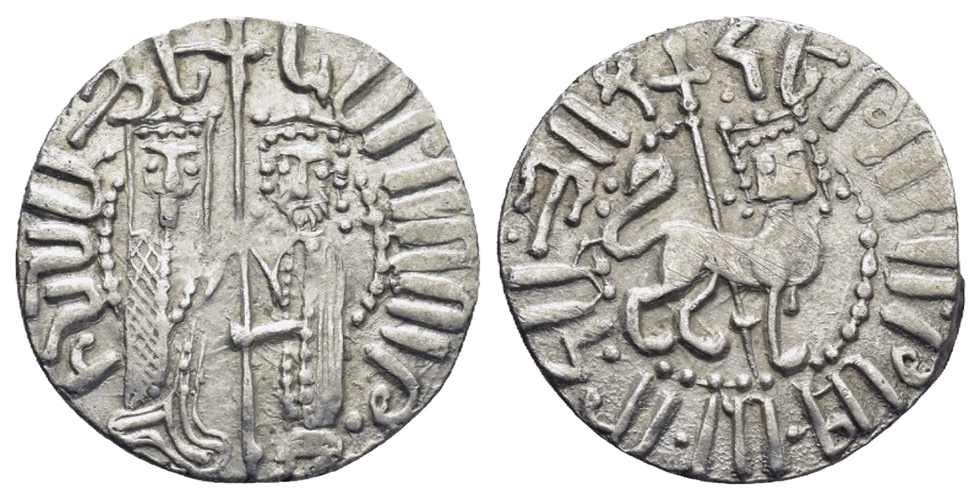
Coin Description
Obverse: Queen Zabel and King Hetum holding a long-shafted cross; Armenian inscription: BY THE POWER OF GOD
Reverse: A crusader lion depicted facing right; Armenian inscription: HETUM, KING OF ARMENIANS
Metal: Silver
Denomination: Dram
Mint: Capital city of Sis
Comments