

King Levon I of the Rubinian Dynasty

Introduction
The beginning of Rubinian rule in Cilicia is generally dated to around 1080. One year earlier, the last Bagratid king of Ani, Gagik II—who had been relocated to Caesarea in 1045—was murdered. Following the king’s death, the nobles who had gathered around him dispersed in different directions, some of whom moved to Cilicia. One of King Gagik II’s close associates was Roupen (Ruben).
The early Rubinians succeeded, by force of arms, in taking control of several fortresses located in the Taurus Mountains. Later, by employing every available means, they gradually conquered the fortresses of Mountainous Cilicia and the cities of Cilician Plain from the Byzantines, Turks, and Crusaders, thus establishing a principality.
After King Kyurike II of Lori, the Rubinian princes were the next Armenian rulers to issue coins bearing Armenian inscriptions.
From Principality to Kingdom
The reign of Levon II, the last ruler of the Armenian Principality of Cilicia, began in 1187 (1187–1198 as prince). On January 6, 1198, he was crowned King of All Armenians (1198–1219). As prince, Levon II—like his predecessors—issued only copper coins, bearing the inscription:
LEVON, SERVANT OF GOD / SON OF STEPANOS
Levon II accurately assessed the geopolitical situation of the late 12th century and skillfully used it to strengthen, consolidate, and elevate the status of Armenian statehood in Cilicia. On the eve of the Third Crusade (1189–1192), through his military successes and energetic diplomatic initiatives, Prince Levon gained the favor of both the Pope and the Holy Roman Emperor, who were in need of a reliable ally to advance their eastern policies.
Negotiations initially conducted with Pope Clement III and Emperor Frederick Barbarossa, and later with Pope Celestine III and Emperor Henry VI, led to the long-desired goal—the restoration of the Armenian kingdom. It was decided to elevate Levon’s state to the rank of an Eastern European kingdom.
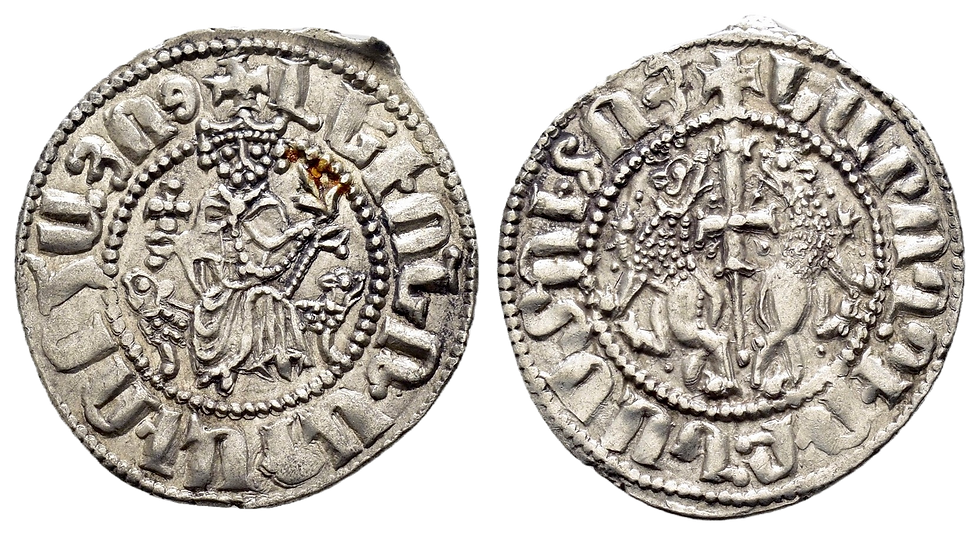
On January 6, 1198, on the Feast of the Nativity, in the Cathedral of Saint Sophia in the city of Tarsus, in the presence of Cilician princes and clergy as well as high-ranking guests from various countries, Prince Levon was crowned “Rex Omnium Armenorum” (King of All Armenians). The coronation was performed according to the Armenian rite by Catholicos of All Armenians Gregory VI Apirat, and according to the Latin rite by Conrad of Wittelsbach, Archbishop of Mainz, representative of the Holy Roman Emperor and the Pope. Levon was crowned with the royal crown sent by Emperor Henry VI and was presented with the symbols of royal authority: the globus cruciger and the fleur-de-lis scepter (as depicted on the obverse of the coin).
The title “Rex” was the designation used by Western monarchs, which Levon adopted and insisted be written in Latin in inscriptions, since the Armenian term for “king” did not fully convey the sovereign rank of “Rex,” which was the highest title after that of emperor.
The Silver Coin of King Levon I Rubinian
In the Levant (the general term for the eastern Mediterranean region), Levon was the first ruler to place his own portrait on coins. He was also the first to include on coins the formula “King … by the Power of God”, which precisely corresponds to the Latin “Dei gratia rex …” (English: By the Grace of God, King; Russian: By God’s grace, king). Prior to Levon, this formula had been used only on seals, including those of Jerusalem.
In the heraldic compositions on the reverse of his silver coins, Levon boldly and skillfully combined the symbolism of the Lamb of God, the lion—symbol of strength and power—and wordplay alluding to his own name. The ideological axis of these compositions was the double-armed Cross, the True Cross of Christ’s Crucifixion—the principal Christian relic and the “weapon” of victory and salvation.
When Levon was crowned King of Armenia in 1198, the chief Christian holy site—the Tomb of the Lord in Jerusalem—as well as the True Cross, symbol of Christ’s Crucifixion, were once again in “captivity.” Even during his princely period, Levon proclaimed himself a servant of Christ on his coins. Later, on his gold seal, he inscribed that he had become king by the will of Christ:
LEON, BY THE WILL OF CHRIST, KING OF ARMENIA
In the iconography of his royal coinage, he expressed the ideology of bearing Christ’s Cross, emulating Him, serving Him, drawing strength from Him, and achieving victory through Him.
The other reverse composition of the silver coins again features the True Cross and the lion. At the center stands the rising Cross. Two lions stand with their backs to the Cross, their forelegs extended forward, yet their heads turned toward the Cross so that their gaze is directed at it as the source of faith and power, while their bodies face outward—ready to defend the Cross from enemies with their formidable physical strength.
Death of King Levon I
King Levon I died in 1219. According to his will, his body was buried in Sis, while his heart was interred in the Monastery of Akner, which he himself had founded.
Coin Description
Obverse: King Levon I the Magnificent seated on a lion-adorned throne, his feet resting on a footstool. In his right hand, the globus cruciger; in his left, the fleur-de-lis scepter. Armenian inscription: LEVON, KING OF ARMENIANS.
Reverse: The True Cross between two crowned lions. Inscription: BY THE POWER OF GOD.
Metal: Silver
Denomination: Dram
Mint: Capital city of Sis
Postscript
“True Cross” — After the defeat of the Crusaders at the Battle of Hattin in 1187, the Cross disappeared, and subsequent accounts of its fate are uncertain and contradictory. The loss of the Holy Cross in the Kingdom of Jerusalem was perceived by Christians throughout the world as a tremendous catastrophe. According to the chronicles of the Third Crusade and the biographies of Saladin, Crusader leaders and other Christian rulers made efforts to recover or reclaim it. This episode is also depicted in the film Kingdom of Heaven starring Orlando Bloom.
Comments